Why you can be confident of God's goodness to you
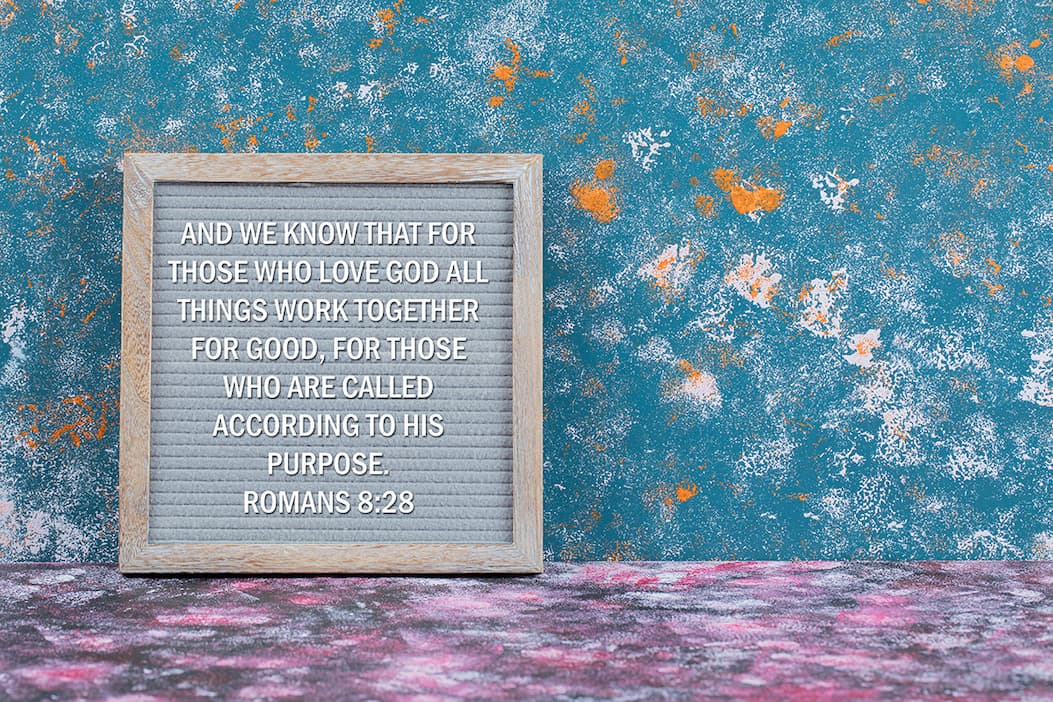
It’s one of the best-known and oft-quoted verses in the Bible, providing encouraging reassurance for Christians and encouraging revenue for manufacturers of wall plaques and bookmarks—Romans 8:28: ‘And we know that for those who love God all things work together for good, for those who are called according to his purpose’.
To be fair, if you’re going to use a Bible verse for decorative purposes, it’s a pretty good one.
But as I studied Romans 8 with our Bible study group last week, it occurred to me that when you read the verse in its context—as opposed to pulling it out and reading it in isolation—it’s even more encouraging.
The reassurance itself is not hard to grasp, is it? God is in sovereign control of all that happens, and he is ensuring that it all happens for our good as Christians.
The interesting thing I noticed afresh, however, is that Paul says as Christians “we know” that to be true.
I’ve been pretty blessed in my life up to this point, and it’s not that hard—by and large—for me to believe that God has been working for my good. But we all know people who seem to have had lives that are full of hardships and suffering. For them, sad events have accumulated year after year, one on top of another, repeatedly stretching their resilience to breaking point. Experientially, for some of our dear brothers and sisters, their trust in God’s goodness can seem almost irrational.
So when Paul says “we know that for those who love God all things work together for good”, how do we know?
That’s where reading in context helps us, because Paul answers that question in the next two verses.
For [because] those whom he foreknew he also predestined to be conformed to the image of his Son, in order that he might be the firstborn among many brothers. And those whom he predestined he also called, and those whom he called he also justified, and those whom he justified he also glorified. (Rom 8:29–30)
Why do we know this truth about God’s intent to do good to us? Because of God’s past record—his history of doing good to us from the beginning of time and his history of doing good to us in the most important ways possible.
So where do we see his good purposes towards us?
We see it in the fact that he predestined us to be conformed to the image of his Son, so that we might be Jesus’ brothers and sisters—those who are adopted by God as his children (8:15–16) and so become his heirs (8:17). Can you grasp the enormity of that? Rebels are predestined to become family members who can address the living God as “Abba! Father!” How good is that?!
But God didn’t just stop at predestining us. He took the initiative to call us—to work so as to draw us to himself, in accordance with his past decision to predestine us. God followed through! How good is that?!
There was a problem though: our sin. He called us to himself, but in our sinful and rebellious state, we were not fit to approach a holy God. Something more needed to be done. So God did it. He “also justified” us. He did this, as we learned earlier in Romans, “by his grace as a gift, through the redemption that is in Christ Jesus, whom God put forward as a propitiation by his blood, to be received by faith” (3:24–25). Now we can approach confidently (Heb 10:19–23), knowing that “we have peace with God” (Rom 5:1). How good is that?!
But it didn’t end there. Paul says something else remarkable: he glorified us. This is a glory that is yet to be “revealed” (8:18), but it’s locked in. Sinful rebels, who deserve to be punished in ignominy and shame, are glorified children of God. How good is that?!
Paul then continues on in verses 31–39 exploring these ideas and their huge benefits for us, culminating in the great truth that nothing “will be able to separate us from the love of God in Christ Jesus our Lord”. How good is that?!
How good is all that? Astonishingly good!
And because of all of that, we can confidently know that “for those who love God all things work together for good”. His track record is immensely reassuring.